Essay Type - Two-Part Essay
A lot of companies and organizations require employees to wear uniforms.
Which kind of jobs are uniforms suitable for?
Are there any disadvantages to wearing a uniform to work?
Essay Type
This question belongs to the Two-Part Question category in IELTS Writing Task 2. In this type of essay, you are asked to address two separate but related questions about a central topic—in this case, the suitability of uniforms for specific jobs and the potential disadvantages of wearing uniforms to work.
What You Are Expected to Do
For this essay, you are expected to:
- First Part: Discuss which types of jobs uniforms are suitable for. This involves identifying specific professions or sectors where wearing a uniform is beneficial or necessary and explaining why.
- Second Part: Address the possible disadvantages of wearing uniforms to work. This requires considering and discussing the negative aspects or implications of uniform policies for employees.
What You Should Do to Answer This Question Effectively
- Introduction: Briefly introduce the topic and mention that you will discuss the suitability of uniforms for specific jobs and explore potential disadvantages.
- Body Paragraph 1: Discuss the types of jobs for which uniforms are suitable. Mention specific sectors (e.g., healthcare, law enforcement, hospitality) and explain the reasons uniforms are beneficial or required in these fields.
- Body Paragraph 2: Address the disadvantages of wearing uniforms to work. Consider aspects such as personal expression, financial cost, or any discomfort and restrictions they may pose to employees.
- Conclusion: Summarize your discussion by reiterating the types of jobs where uniforms are suitable and the main disadvantages identified. You may also offer a final comment on balancing the need for uniforms with addressing their drawbacks.
Topic and Idea Generation
When generating ideas for this essay, consider the following:
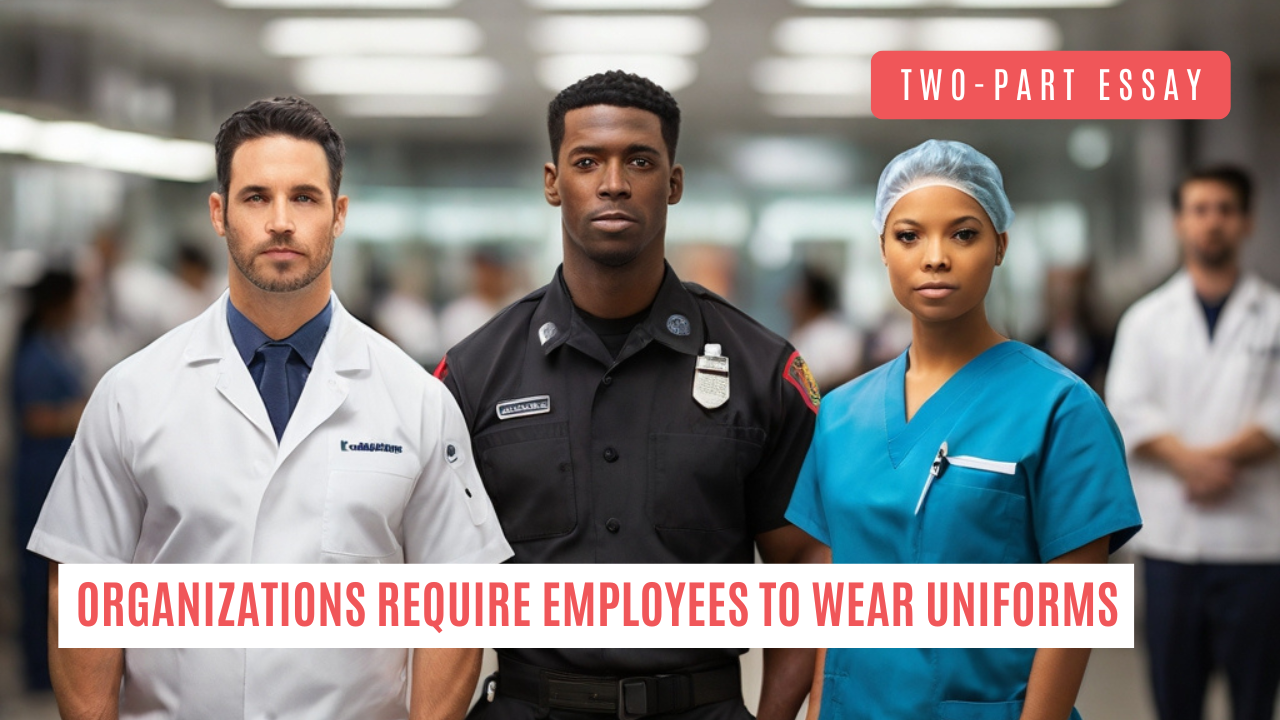
- Suitability of Uniforms: Think about jobs where identification, safety, or branding is key. For example, in healthcare, uniforms can prevent contamination; in law enforcement, they signify authority and help in identification; in the service industry, they promote brand consistency and professionalism.
- Disadvantages: Reflect on how uniforms might affect workers personally and professionally. Consider personal expression—uniforms may limit individuals’ ability to express themselves through their attire. Financial implications—whether employees bear the cost of uniforms can be a concern. Comfort and practicality—uniforms may not always be designed for comfort or suited to all body types, potentially affecting job performance or satisfaction.
- Balancing Perspectives: While addressing both parts of the question, consider how the advantages of wearing uniforms in certain professions might outweigh the disadvantages or discuss potential solutions to mitigate the drawbacks mentioned.
This approach ensures a well-rounded essay that comprehensively covers both aspects of the question, supported by specific examples and a balanced discussion of the topic.
Sample Essay
In many professional settings, the implementation of a uniform policy is a standard practice, aimed at fostering a sense of unity and professionalism among employees. This essay explores the suitability of uniforms for certain job categories and delves into the potential disadvantages associated with their mandatory use.
Uniforms are predominantly deemed suitable for jobs that require immediate recognition and trust from the public, such as in healthcare, law enforcement, and service industries. In healthcare, for instance, uniforms are not only a symbol of cleanliness and hygiene but also allow patients to easily identify medical staff. Similarly, law enforcement officers wear uniforms to be quickly recognized in emergencies, thereby ensuring public safety. In the service sector, uniforms help maintain a consistent brand image, creating a cohesive appearance that aligns with the company’s ethos.
However, mandatory uniform policies are not without their drawbacks. One significant disadvantage is the potential impact on employees’ sense of individuality and expression. Being required to wear a specific attire day in and day out can lead to a sense of monotony and suppress personal expression. Additionally, the financial burden of purchasing and maintaining uniforms can be considerable for employees, especially when the cost is not subsidized by the employer. An example of the discomfort and practical issues associated with uniforms can be seen in the hospitality industry, where staff often report that uniforms are not always designed for comfort or practicality, affecting their ability to perform their duties effectively.
In conclusion, while uniforms are suitable and beneficial for jobs requiring public trust, identification, and brand consistency, they also pose significant disadvantages, including impacts on personal expression and potential financial burdens. Balancing the advantages of uniform policies with measures to mitigate their drawbacks is crucial, ensuring that the professional benefits do not overshadow the personal and financial well-being of employees.
Total word count – 302
Paragraph Breakdown and Analysis
We’ll take a deep dive into the essay’s structure, analyzing how each paragraph fulfills the IELTS Writing Task 2 criteria.
We’ll explore how each sentence contributes to Task Response by directly addressing the prompt and its various aspects.
We’ll also examine Coherence and Cohesion, looking at how ideas flow logically and connect smoothly within and between paragraphs.
Lexical Resource will be analyzed, focusing on the variety and appropriateness of vocabulary used.
Finally, we’ll assess Grammatical Range and Accuracy, examining the complexity and correctness of sentence structures.
Introduction Paragraph
In many professional settings, the implementation of a uniform policy is a standard practice, aimed at fostering a sense of unity and professionalism among employees. This essay explores the suitability of uniforms for certain job categories and delves into the potential disadvantages associated with their mandatory use.
Sentence 1: “In many professional settings, the implementation of a uniform policy is a standard practice, aimed at fostering a sense of unity and professionalism among employees.”
- Task Response: This sentence directly addresses the topic by setting the context for the discussion about uniform policies in professional environments. It implies that the essay will cover why uniforms are used, aligning with the prompt’s requirements.
- Coherence and Cohesion: The sentence smoothly introduces the subject of uniforms in the workplace, effectively starting the essay with a clear topic that will be further explored. The use of “in many professional settings” and “is a standard practice” helps to establish a broad context.
- Lexical Resource: The vocabulary used (“implementation,” “uniform policy,” “fostering,” “unity,” “professionalism”) is precise and relevant to the topic, demonstrating a good range of language.
- Grammatical Range and Accuracy: The sentence is grammatically correct, using a complex structure that combines multiple elements to convey a comprehensive introductory statement.
Sentence 2: “This essay explores the suitability of uniforms for certain job categories and delves into the potential disadvantages associated with their mandatory use.”
- Task Response: It clearly outlines the essay’s structure and focus, directly responding to the two-part question. By stating the essay’s intentions, it prepares the reader for the upcoming discussion.
- Coherence and Cohesion: This sentence acts as a thesis statement, providing a roadmap for the essay. It ensures that the reader knows exactly what aspects will be discussed (“suitability of uniforms” and “potential disadvantages”), which enhances the essay’s organization.
- Lexical Resource: The choice of verbs “explores” and “delves into” suggests a thorough examination of the topic, indicating depth in the upcoming analysis. The use of “mandatory use” specifically targets the nature of the policies being discussed.
- Grammatical Range and Accuracy: The sentence structure is complex and accurately constructed, employing coordination to link two main ideas in a single sentence, showcasing the writer’s ability to handle complex grammatical constructions effectively.
Overall, the introduction effectively sets the stage for the essay, adhering to IELTS Writing Task 2 criteria by presenting a clear and concise overview of the topic, outlining the scope of the discussion, and demonstrating a strong command of language and grammar.
Body Paragraph 1 (Suitability of Uniforms Across Various Professions)
Uniforms are predominantly deemed suitable for jobs that require immediate recognition and trust from the public, such as in healthcare, law enforcement, and service industries. In healthcare, for instance, uniforms are not only a symbol of cleanliness and hygiene but also allow patients to easily identify medical staff. Similarly, law enforcement officers wear uniforms to be quickly recognized in emergencies, thereby ensuring public safety. In the service sector, uniforms help maintain a consistent brand image, creating a cohesive appearance that aligns with the company’s ethos.
Sentence 1: “Uniforms are predominantly deemed suitable for jobs that require immediate recognition and trust from the public, such as in healthcare, law enforcement, and service industries.”
- Task Response: This sentence directly addresses the first part of the question by identifying the types of jobs where uniforms are deemed suitable, fulfilling the requirement to discuss suitability for certain job categories.
- Coherence and Cohesion: It provides a clear topic sentence that sets up the content of the paragraph, enhancing the logical flow of ideas. The inclusion of examples (healthcare, law enforcement, service industries) previews the specific areas that will be elaborated upon.
- Lexical Resource: The use of “predominantly deemed suitable” and “immediate recognition and trust” demonstrates effective use of language to convey the perceived importance and function of uniforms in certain professions.
- Grammatical Range and Accuracy: The sentence structure is complex, incorporating a passive voice (“are deemed suitable”) accurately, which adds variety to the grammatical constructions used in the essay.
Sentence 2: “In healthcare, for instance, uniforms are not only a symbol of cleanliness and hygiene but also allow patients to easily identify medical staff.”
- Task Response: Provides a specific example (healthcare) to support the general statement made in the first sentence, illustrating the practical benefits of uniforms in a critical sector.
- Coherence and Cohesion: This sentence builds on the previous one by offering a detailed instance of where uniforms serve a crucial function, maintaining the paragraph’s focus and coherence.
- Lexical Resource: The phrase “not only a symbol of cleanliness and hygiene but also” effectively uses advanced language structures to present a balanced view of uniforms’ symbolic and functional roles.
- Grammatical Range and Accuracy: Employs a complex sentence structure that includes a correlative conjunction (“not only… but also”), demonstrating grammatical precision and range.
Sentence 3: “Similarly, law enforcement officers wear uniforms to be quickly recognized in emergencies, thereby ensuring public safety.”
- Task Response: Continues to provide relevant examples (law enforcement) that underline the importance of uniforms for public identification and safety, directly linking back to the essay prompt’s inquiry.
- Coherence and Cohesion: Uses “Similarly” to draw a parallel with the previous example, aiding the seamless transition between ideas and maintaining the paragraph’s cohesive structure.
- Lexical Resource: The inclusion of specific roles (“law enforcement officers”) and the precise purpose of uniforms in these roles (“to be quickly recognized in emergencies”) showcases a rich vocabulary pertinent to the discussion.
- Grammatical Range and Accuracy: The sentence is well-constructed, utilizing an infinitive phrase (“to be quickly recognized”) effectively, which keeps the sentence grammatically sound and clear.
Sentence 4: “In the service sector, uniforms help maintain a consistent brand image, creating a cohesive appearance that aligns with the company’s ethos.”
- Task Response: Expands the argument by introducing another domain (the service sector) where uniforms play a significant role, addressing the essay’s requirement to discuss various job categories.
- Coherence and Cohesion: This sentence adds depth to the discussion by covering a different aspect of uniform utility—brand image and ethos—further elaborating on the broad applicability of uniforms across sectors.
- Lexical Resource: Utilizes terms like “consistent brand image,” “cohesive appearance,” and “company’s ethos” to articulate the branding and cultural implications of uniform policies.
- Grammatical Range and Accuracy: Demonstrates the use of participles (“maintain,” “creating”) in a complex sentence structure, maintaining accuracy and showcasing a varied grammatical range.
Overall, the first body paragraph effectively addresses the task by detailing where uniforms are suitable, supports the discussion with relevant examples, and uses a range of cohesive devices, vocabulary, and grammatical structures to present a coherent and well-argued response.
Body Paragraph 2 (Challenges and Disadvantages of Mandatory Uniform Policies)
However, mandatory uniform policies are not without their drawbacks. One significant disadvantage is the potential impact on employees’ sense of individuality and expression. Being required to wear a specific attire day in and day out can lead to a sense of monotony and suppress personal expression. Additionally, the financial burden of purchasing and maintaining uniforms can be considerable for employees, especially when the cost is not subsidized by the employer. An example of the discomfort and practical issues associated with uniforms can be seen in the hospitality industry, where staff often report that uniforms are not always designed for comfort or practicality, affecting their ability to perform their duties effectively.
Sentence 1: “However, mandatory uniform policies are not without their drawbacks.”
- Task Response: This sentence introduces the discussion of the disadvantages of uniform policies, directly responding to the second part of the essay question.
- Coherence and Cohesion: The use of “However” serves as a transition, signaling a shift from discussing the advantages to examining the disadvantages, which maintains the essay’s logical flow.
- Lexical Resource: The phrase “not without their drawbacks” is an effective way to introduce the concept of disadvantages, demonstrating nuanced language use.
- Grammatical Range and Accuracy: The sentence is grammatically correct and uses a simple structure to clearly state the upcoming discussion focus.
Sentence 2: “One significant disadvantage is the potential impact on employees’ sense of individuality and expression.”
- Task Response: Directly identifies a key disadvantage of uniform policies, meeting the task’s requirement to discuss the negative aspects.
- Coherence and Cohesion: Acts as a topic sentence for the specific disadvantage being discussed, clearly linking back to the introduction of drawbacks.
- Lexical Resource: “Sense of individuality and expression” is a precise and contextually appropriate phrase that accurately conveys the nature of the disadvantage.
- Grammatical Range and Accuracy: Uses a simple sentence structure effectively to present a clear and concise point.
Sentence 3: “Being required to wear a specific attire day in and day out can lead to a sense of monotony and suppress personal expression.”
- Task Response: Provides an explanation of how uniform policies can negatively impact employees, elaborating on the disadvantage mentioned previously.
- Coherence and Cohesion: Continues to develop the idea introduced in the previous sentence, enhancing the paragraph’s coherence by detailing the negative effect on personal expression.
- Lexical Resource: The phrase “day in and day out” effectively conveys the repetitive nature of wearing a uniform, while “sense of monotony” and “suppress personal expression” are well-chosen expressions that deepen the discussion of disadvantages.
- Grammatical Range and Accuracy: Exhibits a complex sentence structure with a gerund (“Being required”) as the subject, showing grammatical variety and accuracy.
Sentence 4: “Additionally, the financial burden of purchasing and maintaining uniforms can be considerable for employees, especially when the cost is not subsidized by the employer.”
- Task Response: Introduces another significant disadvantage, addressing the financial aspect, which responds well to the task’s requirement to explore potential downsides.
- Coherence and Cohesion: The use of “Additionally” smoothly adds another layer to the discussion of disadvantages, maintaining the flow and building on the argument.
- Lexical Resource: “Financial burden,” “purchasing and maintaining,” and “subsidized by the employer” are terms that specifically relate to the economic considerations of uniforms, showing effective vocabulary use.
- Grammatical Range and Accuracy: The sentence structure is more complex, incorporating a conditional clause (“when the cost is not subsidized”), enhancing the grammatical range while remaining accurate.
Sentence 5: “An example of the discomfort and practical issues associated with uniforms can be seen in the hospitality industry, where staff often report that uniforms are not always designed for comfort or practicality, affecting their ability to perform their duties effectively.”
- Task Response: Provides a concrete example to illustrate the previously mentioned disadvantages, fulfilling the task’s requirement for specific evidence or illustration.
- Coherence and Cohesion: This sentence effectively uses an example to support and elaborate on the disadvantages discussed, enhancing the essay’s argumentative structure.
- Lexical Resource: The detailed description (“discomfort and practical issues,” “not always designed for comfort or practicality”) uses precise and varied language to discuss the impact of uniforms.
- Grammatical Range and Accuracy: Demonstrates the ability to use complex sentences effectively, including a relative clause (“where staff often report”), which adds detail and clarity without sacrificing grammatical accuracy.
Overall, the second paragraph comprehensively addresses the disadvantages of uniform policies, supporting the discussion with specific details and examples. It effectively uses a range of lexical resources and grammatical structures, maintaining coherence and cohesion throughout.
Conclusion
In conclusion, while uniforms are suitable and beneficial for jobs requiring public trust, identification, and brand consistency, they also pose significant disadvantages, including impacts on personal expression and potential financial burdens. Balancing the advantages of uniform policies with measures to mitigate their drawbacks is crucial, ensuring that the professional benefits do not overshadow the personal and financial well-being of employees.
Sentence 1: “In conclusion, while uniforms are suitable and beneficial for jobs requiring public trust, identification, and brand consistency, they also pose significant disadvantages, including impacts on personal expression and potential financial burdens.”
- Task Response: This sentence effectively summarizes the essay’s main arguments, addressing both parts of the question (the suitability of uniforms for certain jobs and the disadvantages of wearing uniforms). It provides a balanced overview of the points discussed, fulfilling the requirement to summarize the essay’s findings.
- Coherence and Cohesion: The use of “In conclusion” signals the reader that the essay is drawing to a close and provides a summary of the main points, enhancing the overall cohesion and coherence of the text.
- Lexical Resource: The sentence employs a rich variety of vocabulary (“suitable and beneficial,” “public trust, identification, and brand consistency,” “significant disadvantages,” “impacts on personal expression and potential financial burdens”) that concisely encapsulates the essay’s key points.
- Grammatical Range and Accuracy: The complex sentence structure, with multiple clauses and balanced contrasts (“while… they also”), demonstrates a high level of grammatical control and accuracy.
Sentence 2: “Balancing the advantages of uniform policies with measures to mitigate their drawbacks is crucial, ensuring that the professional benefits do not overshadow the personal and financial well-being of employees.”
- Task Response: Goes beyond merely summarizing the essay by suggesting a way forward, addressing the implied question of how to reconcile the advantages and disadvantages of uniform policies. This adds depth to the essay’s conclusion, providing a final evaluative comment that reflects a comprehensive understanding of the issue.
- Coherence and Cohesion: This sentence effectively ties the essay’s arguments together, suggesting a solution that considers both sides of the issue discussed, thus reinforcing the essay’s overall argumentative structure.
- Lexical Resource: The choice of words (“Balancing,” “mitigate their drawbacks,” “crucial,” “professional benefits,” “overshadow,” “personal and financial well-being”) is precise and nuanced, effectively conveying the conclusion’s key message.
- Grammatical Range and Accuracy: Utilizes a complex sentence structure that combines an imperative form (“Balancing”) with a participle clause (“ensuring”), showing grammatical sophistication and accuracy.
Overall, the conclusion effectively encapsulates the essay’s discussion, reiterating the main points about the suitability of uniforms and their disadvantages, and suggesting a balanced approach to policy implementation. It demonstrates a strong command of task response, coherence and cohesion, lexical resource, and grammatical range and accuracy, fulfilling the criteria for a high-band IELTS Writing Task 2 essay.
Vocabulary and Collocations Used
Here’s a comprehensive list of the vocabulary and collocations used in the essay, along with their meanings:
In many professional settings, the implementation of a uniform policy is a standard practice, aimed at fostering a sense of unity and professionalism among employees. This essay explores the suitability of uniforms for certain job categories and delves into the potential disadvantages associated with their mandatory use.
- Professional settings: Workplaces or environments where professions are practiced, often requiring a degree of formality or adherence to specific standards.
- Implementation: The process of putting a decision or plan into effect.
- Uniform policy: A rule or set of rules mandating the wearing of a specific attire by members of an organization.
- Standard practice: Something that is done regularly and widely accepted as a procedure or method.
- Aimed at: Intended to achieve a certain goal.
- Fostering: Encouraging or promoting the development of something.
- Sense of unity: A feeling of being united or joined as a whole.
- Professionalism: The competence or skill expected of a professional.
- Explores: Investigates or examines something in detail.
- Suitability: The quality of being right or appropriate for a particular purpose.
- Job categories: Different types or classifications of employment based on the nature of the job.
- Delves into: Looks into something deeply and thoroughly.
- Potential disadvantages: Possible or likely drawbacks or negative aspects.
- Associated with: Connected or linked to something.
- Mandatory use: Required or compulsory implementation.
Uniforms are predominantly deemed suitable for jobs that require immediate recognition and trust from the public, such as in healthcare, law enforcement, and service industries. In healthcare, for instance, uniforms are not only a symbol of cleanliness and hygiene but also allow patients to easily identify medical staff. Similarly, law enforcement officers wear uniforms to be quickly recognized in emergencies, thereby ensuring public safety. In the service sector, uniforms help maintain a consistent brand image, creating a cohesive appearance that aligns with the company’s ethos.
- Predominantly: Mostly or mainly.
- Deemed suitable: Considered appropriate or fitting.
- Immediate recognition: Quickly identified or acknowledged at first sight.
- Trust from the public: Confidence or reliability perceived by society.
- Healthcare: The field concerned with the maintenance or improvement of health.
- Law enforcement: The agencies responsible for the enforcement of laws.
- Service industries: Businesses that provide services rather than goods.
- Symbol of cleanliness and hygiene: A representation or emblem of being clean and maintaining health standards.
- Easily identify: To recognize with no difficulty.
- Medical staff: Professionals working in the field of medicine, such as doctors and nurses.
- Similarly: In a like manner; likewise.
- Recognized in emergencies: Identified quickly during urgent situations.
- Ensuring public safety: Guaranteeing the protection of the general population.
- Service sector: The segment of the economy that provides services.
- Maintain a consistent brand image: Keep a uniform representation of a company’s identity.
- Cohesive appearance: Unified or coherent look.
- Aligns with the company’s ethos: Matches or corresponds with the principles and values of the organization.
However, mandatory uniform policies are not without their drawbacks. One significant disadvantage is the potential impact on employees’ sense of individuality and expression. Being required to wear a specific attire day in and day out can lead to a sense of monotony and suppress personal expression. Additionally, the financial burden of purchasing and maintaining uniforms can be considerable for employees, especially when the cost is not subsidized by the employer. An example of the discomfort and practical issues associated with uniforms can be seen in the hospitality industry, where staff often report that uniforms are not always designed for comfort or practicality, affecting their ability to perform their duties effectively.
- However: Used to introduce a statement that contrasts with or seems to contradict something that has been said previously.
- Mandatory: Required by law or rules; compulsory.
- Uniform policies: Rules or guidelines established by an organization that dictate the specific attire to be worn by employees.
- Drawbacks: Disadvantages or negative aspects.
- Significant: Considerable in degree, size, or importance.
- Disadvantage: An unfavorable condition or situation that reduces the chances of success or effectiveness.
- Potential impact: Possible effects or influence something may have in the future.
- Sense of individuality: The feeling or perception of being unique or distinct from others.
- Expression: The process of making known one’s thoughts or feelings.
- Being required: Being obligated or mandated to do something.
- Specific attire: Particular or specified clothing.
- Day in and day out: Every day; continuously or repeatedly over a long period of time.
- Sense of monotony: A feeling of boredom or tedious repetition.
- Suppress: To forcibly put an end to; to stop by force.
- Personal expression: The ability to express one’s own personality, feelings, or ideas.
- Additionally: Furthermore; also.
- Financial burden: Economic or monetary hardship or strain.
- Purchasing and maintaining: Buying and keeping something in good condition through regular care.
- Considerable: Substantial in size, amount, or degree.
- Subsidized by the employer: Financially supported or partially paid for by the company.
- Discomfort: A lack of comfort or ease; uneasiness or pain.
- Practical issues: Problems related to the practical or actual experience of something rather than theories or ideas.
- Hospitality industry: A broad category of fields within the service industry that includes lodging, food and drink service, event planning, theme parks, travel, and tourism.
- Staff often report: Employees frequently state or declare, typically based on personal experience or observation.
- Not always designed for comfort or practicality: Sometimes lacking consideration for ease of use or suitability for the intended purpose.
- Affecting their ability: Influencing or impacting their capacity.
- Perform their duties effectively: Execute their responsibilities in an efficient and successful manner.
In conclusion, while uniforms are suitable and beneficial for jobs requiring public trust, identification, and brand consistency, they also pose significant disadvantages, including impacts on personal expression and potential financial burdens. Balancing the advantages of uniform policies with measures to mitigate their drawbacks is crucial, ensuring that the professional benefits do not overshadow the personal and financial well-being of employees.
- In conclusion: A phrase used to indicate the final part of a discourse, signaling the summary or final argument.
- Suitable: Appropriate or fitting for a particular purpose or situation.
- Beneficial: Producing good effects; advantageous.
- Jobs requiring public trust: Positions in which the public must have confidence in the integrity and reliability of the individuals.
- Identification: The process of recognizing or establishing as being a particular person or thing.
- Brand consistency: The practice of always presenting the brand in a consistent manner, through visual design, messaging, and overall corporate identity.
- Significant disadvantages: Major or important drawbacks.
- Impacts on personal expression: Effects on individuals’ ability to express their personality or preferences, typically through their choice of clothing.
- Potential financial burdens: Possible financial pressures or hardships.
- Balancing: The act of maintaining or bringing something into a state of equilibrium.
- Advantages of uniform policies: The benefits or positive aspects of rules requiring the wearing of specific attire.
- Measures to mitigate: Actions taken to reduce the severity, seriousness, or painfulness of something.
- Drawbacks: Disadvantages or negative aspects.
- Crucial: Extremely important or necessary.
- Ensuring: Making certain that something shall occur or be the case.
- Professional benefits: The advantages or positive outcomes related to one’s career or professional life.
- Do not overshadow: To prevent from being less noticeable, important, or significant.
- Personal and financial well-being: The state of being comfortable, healthy, or happy in one’s personal life and financial situation.
- Employees: People who are paid to work for a company or organization.
This list covers a broad range of lexical resources employed in the essay, showcasing the use of sophisticated vocabulary and collocations to articulate ideas clearly and effectively.
Essay Variation 1
Uniform policies are a common feature in many workplaces, aiming to promote a professional image and team unity. This essay assesses the roles that benefit most from wearing uniforms and discusses the potential negative impacts of such policies.
Uniforms are particularly useful in professions where quick recognition and trust are essential. Healthcare workers, for instance, wear uniforms to ensure they are easily identifiable to patients and colleagues, fostering an environment of trust and efficiency. Similarly, uniforms are vital in law enforcement, where they symbolize authority and help in distinguishing officers from civilians, crucial for maintaining public safety. In customer service roles, uniforms contribute to a consistent brand presentation, supporting a professional company image.
However, the requirement to wear a uniform daily has its drawbacks. One major concern is the limitation it places on personal expression. Employees might feel their individuality is compromised when they are unable to express themselves through their choice of attire. This can lead to a lack of motivation and job satisfaction. Furthermore, the financial aspect of uniforms, including their purchase and maintenance, can pose a burden, particularly if the employer does not cover these costs. The hospitality industry provides an example where the need for a specific uniform can lead to additional financial strain on workers, alongside concerns about comfort and practicality that may affect job performance.
In conclusion, while uniforms have their place in certain sectors by enhancing recognition, trust, and brand consistency, they also present challenges related to personal freedom and financial impact. It is crucial for organizations to balance the benefits of uniform policies with consideration for the individual needs and well-being of their employees, ensuring that the professional advantages do not detract from personal and financial comfort.
Total word count – 285
We hope this post has made writing IELTS essays about uniforms at work easier for you. We have covered everything from what the essay is about to how to write it well, along with a sample essay to guide you. We wish you good luck with your IELTS study and English learning journey!