
If you are planning to study, work, or migrate to an English-speaking country, you may need to take an English language test to prove your proficiency. One of the most popular and widely recognized tests is IELTS, which stands for the International English Language Testing System. In this blog post, we will give you an in-depth overview of what IELTS is, how it works, and why you should take it.
What is IELTS?
IELTS is a test that assesses your ability to use English in four key skills: listening, reading, writing, and speaking. It is designed to reflect how you will use English in real-life situations, such as studying, working, or socializing. IELTS is jointly owned and run by the British Council, IDP IELTS, and Cambridge University Press & Assessment, which are some of the world’s leading experts in language assessment and education. IELTS has been setting the standard for English language testing for more than 40 years, and it is trusted by over 12,000 organizations in over 140 countries, including governments, universities, employers, and professional bodies. IELTS is also accepted for immigration purposes by Australia, Canada, New Zealand, and the United Kingdom.
Opening Doors Worldwide
Australia
Whether for an Australian visa or employer/educational institution requirements, IELTS opens doors to opportunities. It assesses your skills in listening, reading, writing, and speaking, accepted by the Australian immigration service and various organizations.
Canada
To secure a Canadian visa, you must demonstrate English language skills meeting the standards set by Immigration, Refugees and Citizenship Canada (IRCC). An IELTS score serves as a reliable testament to your capabilities.
New Zealand
Achieve your dream of living, working, or studying in New Zealand by presenting your IELTS results, accepted by Immigration New Zealand as evidence of your English abilities.
United Kingdom
IELTS is accepted by the UK Visas and Immigration (UKVI) for those aiming to live, work, or study in the UK. Ensure you take the correct version of the test, such as IELTS for UKVI (Academic) or IELTS for UKVI (General Training).
United States of America
If you’re applying for college or employment in the USA, an IELTS score is a trusted proof of your English proficiency, meeting the necessary requirements.
How does IELTS work?
IELTS has two versions: IELTS Academic and IELTS General Training. You need to choose the right version for your purpose and destination. IELTS Academic is for people who want to study at a higher education level or work in a professional field that requires a high level of English. IELTS General Training is for people who want to study at a lower level, work in a non-professional field, or migrate to an English-speaking country. Both versions have the same listening and speaking sections but different reading and writing sections.
The total test time is 2 hours, 44 minutes, plus 10 minutes of transfer time. You will do the Listening, Reading, and Writing sections one after another, without any pause. The Listening section comes first, followed by the Reading and Writing sections. The Speaking section may be on a different day, up to a week before or after the test date, depending on the test center.
Listening
You will listen to four recordings of native English speakers and answer 40 questions based on what you hear. The recordings include a conversation between two people, a monologue set in an everyday social context, a conversation among up to four people set in an educational or training context, and a monologue on an academic subject.
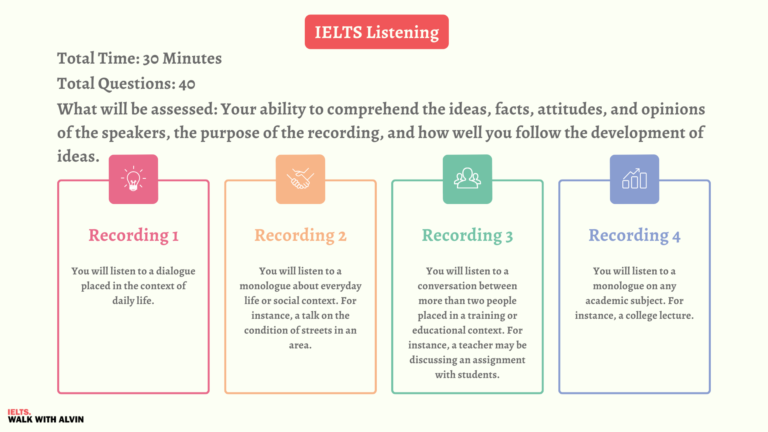
Total Time: 30 Minutes
Total Questions: 40
What will be assessed: Your ability to comprehend the ideas, facts, attitudes, and opinions of the speakers, the purpose of the recording, and how well you follow the development of ideas.
Recording 1
You will listen to a dialogue placed in the context of daily life.
Recording 2
You will listen to a monologue about everyday life or social context. For instance, a talk on the condition of streets in an area.
Recording 3
You will listen to a conversation between more than two people placed in a training or educational context. For instance, a teacher may be discussing an assignment with students.
Recording 4
You will listen to a monologue on any academic subject. For instance, a college lecture.
Reading
You will read three passages and answer 40 questions based on what you read. The passages are taken from books, journals, magazines, or newspapers. The topics are of general interest and suitable for test-takers entering undergraduate or postgraduate courses or seeking professional registration. The passages are different for Academic and General Training versions.
Total Time: 60 Minutes
Total Questions: 40
What will be assessed: Your ability to read and understand texts in English and answer questions based on them. The test is graded on a 9-band scale based on four criteria: lexical resource, grammatical range and accuracy, coherence and cohesion, and task achievement.
General
Section 1
This section contains 2-3 short texts about everyday topics, such as advertisements, timetables, booklets, or announcements. The questions test your ability to understand the most common types of texts in an English-speaking environment.
Section 2
This section contains 2 texts about work or education topics, such as job descriptions, training courses, or school programs. The questions test your ability to understand factual information and follow instructions.
Section 3
This section contains 1 long text about a general-interest topic, such as science, history, or culture. The text is usually taken from a book, journal, magazine, or newspaper. The questions test your ability to understand the main ideas, details, opinions, and arguments of the text.
Academic
Section 1
This section contains a text that describes or explains something, such as a process, a phenomenon, or a concept. The questions test your ability to understand the main idea, the details, and the vocabulary of the text.
Section 2
This section contains a text that analyzes or evaluates something, such as an argument, a theory, or a perspective. The questions test your ability to understand the purpose, the structure, and the opinions of the text.
Section 3
This section contains a text that discusses or compares something, such as research, a problem, or a solution. The questions test your ability to understand the implications, the assumptions, and the evidence of the text.
Writing
You will write two tasks based on the topics given. The topics are different for Academic and General Training versions. In Task 1, you will describe, summarize, or explain some visual information, such as a graph, table, chart, or diagram. In Task 2, you will write an essay in response to a point of view, argument, or problem. You will be assessed on your ability to organize your ideas, use appropriate vocabulary and grammar, and present a clear and coherent argument.
Total Time: 60 Minutes
Total Questions: 2 (Task 1 and Task 2)
What will be assessed: Your ability to express ideas coherently and cohesively, as well as your proficiency in organizing information and using a range of vocabulary and grammatical structures to convey their message effectively. Additionally, candidates are evaluated on their task response, including how well they address the prompt and their ability to maintain a clear and logical progression of ideas throughout the essay.
General
Task 1
Candidates are asked to write a letter in response to a given situation, which may involve making an inquiry, providing information, or expressing a complaint. The letter is typically addressed to a specific person or organization, and candidates are expected to maintain an appropriate tone and style based on the context provided.
Task 2
Candidates are required to write an essay in response to a prompt that presents a point of view, argument, or problem. The task assesses the candidate's ability to present and support opinions, analyze ideas, and engage in a coherent and well-structured written discourse.
Academic
Task 1
Candidates are presented with a visual representation of information, such as a graph, chart, table, or diagram, and are required to describe and interpret the data. The task assesses the candidate's ability to analyze and present information in a clear, organized, and coherent manner.
Task 2
Candidates are required to write an essay in response to a prompt that presents a point of view, argument, or problem. The task assesses the candidate's ability to present and support opinions, analyze ideas, and engage in a coherent and well-structured written discourse.
Speaking
You will have a face-to-face interview with an examiner, who will ask you questions and record your answers. The interview consists of three parts.
In Part 1, you will introduce yourself and answer some general questions about yourself, such as your home, family, work, studies, or interests.
In Part 2, you will be given a topic card and one minute to prepare a short talk on that topic. You will then speak for up to two minutes, and the examiner will ask you one or two questions on the same topic.
In Part 3, you will have a discussion with the examiner on more abstract issues and ideas related to the topic in Part 2. You will be assessed on your ability to communicate opinions and information, express and justify your views, and use a range of vocabulary and grammar.
Total Time: 11-14 Minutes
How many parts: 3
What will be assessed: Candidates are assessed on their ability to communicate fluently and coherently, demonstrate a wide range of vocabulary and grammatical structures, and exhibit clear pronunciation. The evaluation criteria include fluency, vocabulary usage, grammatical accuracy, pronunciation, and interactive communication skills across three distinct parts of the test.
Part 1
The examiner asks the candidate questions about familiar topics such as personal information, studies, work, and general interests, aiming to assess the candidate's ability to provide clear and coherent responses to everyday questions.
Part 2
Candidates receive a task card with a topic and have one minute to prepare and take notes before speaking for 1-2 minutes on the given topic. This section evaluates the candidate's ability to organize and express ideas coherently within a specific time frame.
Part 3
More in-depth discussion with the examiner on abstract and complex issues related to the topic from Part 2. It assesses the candidate's ability to engage in detailed conversations, express opinions, and respond thoughtfully to more challenging questions.
Why should you take IELTS?
There are many benefits of taking IELTS, such as:
- It is a reliable and valid measure of your English language skills, as it is based on extensive research and rigorous quality standards.
- It is a fair and unbiased test, as it is administered by trained and qualified examiners and marked by experts using standardized criteria.
- It is a flexible and convenient test, as it is available in over 1600 locations around the world, with up to 48 test dates per year. You can also choose between paper-based or computer-delivered formats, depending on your preference and availability.
- It is a comprehensive and relevant test, as it covers all the skills and situations you will encounter in an English-speaking environment, whether for academic, professional, or personal purposes.
- It is a recognized and respected test, as it is accepted by thousands of organizations worldwide, including top universities, employers, and immigration authorities. It can help you achieve your goals and dreams, whether you want to pursue higher education, advance your career, or settle in a new country.
Band Scores Explained
The IELTS test provides band scores on a scale from 0 to 9, with Band 9 representing the highest proficiency level, Band 1 indicating the lowest, and Band 0 indicating the test taker did not attempt the exam.
Band 9
Expert User
Band 8
Very Good User
Band 7
Good User
Band 6
Competent User
Band 5
Modest User
Band 4
Limited User
Band 3
Extremely Limited User
Band 2
Intermittent User
Band 1
Non-User
Band 0
Did not attempt the test
These bands represent different levels of English language proficiency. The score you receive in each section (Listening, Reading, Writing, Speaking) contributes to your overall band score. Institutions and organizations may have specific requirements for the minimum band score they accept, so it’s essential to check their guidelines.
Now that we’ve explained what IELTS is, I am sure you are curious to learn more about the IELTS exam. Find more answers on the pages below or visit the IELTS Overview page for specific questions and answers.
Let’s keep exploring together!